
HCOOH CH2 H2O: Structure, Properties, and Industrial Uses
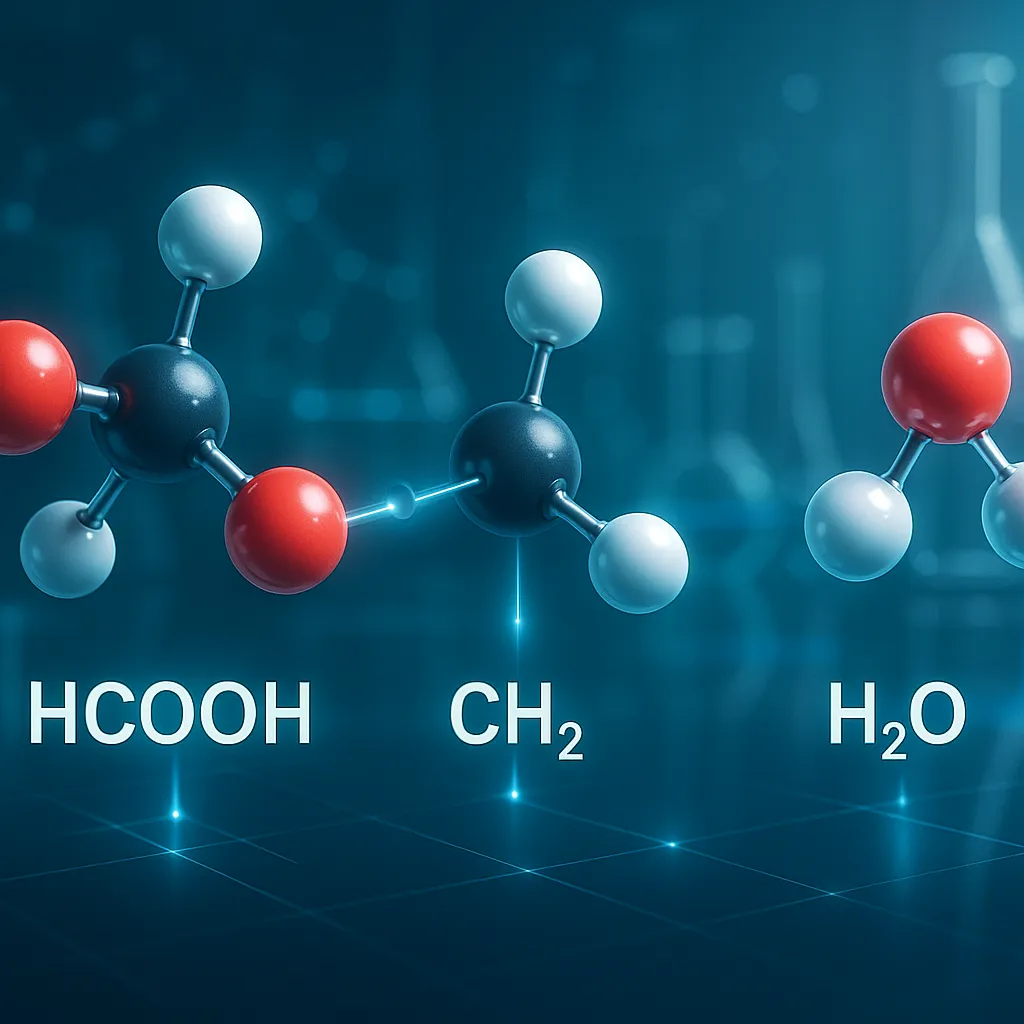
HCOOH CH2 H2O: Structure, Properties, and Key Uses
From hydrogen fuel cells to leather tanning, the combination of HCOOH, CH2, and H2O plays a surprisingly powerful role in both science and industry. While this formula looks like a single compound, it is actually a shorthand expression for three different chemical components that often appear together in reactions and industrial systems.
- HCOOH → formic acid, the simplest carboxylic acid
- CH2 → a methylene group, a fundamental unit in organic chemistry
- H2O → water, the universal solvent and reaction partner
When these three interact, they drive processes in polymer chemistry, esterification, hydrolysis, hydrogen storage, and industrial production. Let’s break down their properties, significance, and applications.
Breaking Down the Components
Formic Acid (HCOOH) – The Simplest Carboxylic Acid
Formic acid is a clear, pungent liquid that occurs naturally in ants, bees, and stinging plants. Industrially, it is produced by hydrolyzing methyl formate or reacting carbon monoxide with water in the presence of a catalyst.
Key properties and uses:
- Strong proton donor, effective in esterification and redox reactions
- Preservative due to antibacterial properties
- Unique azeotrope with water (77.5% concentration, boiling at 107.3°C) — important for separation and purification
Methylene (CH2) – The Carbon Connector
The CH2 group, one carbon atom bonded to two hydrogens, is fundamental in organic chemistry. While it cannot exist alone under normal conditions, it forms the backbone of polymers and impacts flexibility, reactivity, and melting points.
In special cases, CH2 represents methylene carbene, a reactive species capable of:
- Adding to double bonds
- Initiating polymerization
- Triggering rearrangements
Most methylene units in practice come from compounds like methanol (CH3OH) or formaldehyde (CH2O).
Water (H2O) – The Universal Solvent
Water is central to chemistry, acting as:
- Solvent – dissolving reactants and accelerating reactions
- Reactant – participating in hydrolysis, hydration, and esterification
- Product – formed in condensation reactions
Its polarity and hydrogen bonding make it indispensable in both organic and inorganic systems.
Chemical Significance of HCOOH CH2 H2O
When formic acid, methylene, and water occur together, they drive several critical processes:
- Hydrolysis – breaking esters or amides into acids and alcohols/amines
- Esterification – combining acids and alcohols to form esters, with water as a byproduct
- Redox reactions – formic acid functioning as a reducing or oxidizing agent
- Polymer chemistry – methylene groups interacting with acid/water systems to form functional polymers
This trio often signals a chemically active system with wide industrial potential.
Industrial and Laboratory Applications
Formic Acid in Manufacturing
Formic acid’s acidity and reducing power make it valuable for:
- Leather tanning – stabilizing proteins in hides
- Textile finishing – adjusting pH and fixing dyes
- Rubber coagulation – aiding latex processing
- Preservation – preventing bacterial growth in animal feed
In these cases, water is used to dilute the acid, while methylene-containing compounds often act as reactants or solvents.
Synthesis of Methyl Compounds
A classic example is the esterification reaction:
HCOOH + CH3OH ⇌ HCOOCH3 + H2O
This process produces methyl formate, an important intermediate. Hydrolysis of methyl formate reverses the reaction, regenerating formic acid and methanol.
Fuel Cells and Hydrogen Storage
Formic acid is a promising liquid hydrogen carrier for fuel cells. Its decomposition:
HCOOH → H2 + CO2
occurs under mild conditions, making it attractive for clean energy. In water-based systems, methylene-containing catalysts can improve reaction efficiency and hydrogen release rates.
Key Reactions Involving HCOOH CH2 H2O
- Esterification – Formic acid reacts with alcohols (often methylene-based) to produce esters and water. Removing water or using excess alcohol shifts equilibrium toward ester formation.
- Hydrolysis – Water breaks esters into acids and alcohols, accelerated by acids or bases.
- Formaldehyde generation – Under certain conditions, formic acid and methylene compounds yield formaldehyde (CH2O), critical for resins and plastics.
Environmental and Safety Considerations
Handling Formic Acid
Formic acid is corrosive and can cause skin burns or respiratory irritation. Always:
- Use in well-ventilated areas
- Wear gloves, goggles, and protective clothing
- Store in corrosion-resistant containers
Waste Management
Processes involving these chemicals can release VOCs and CO2. Proper treatment and disposal in compliance with environmental laws are essential.
Role in Research and Analytical Chemistry
- Liquid Chromatography – Formic acid-water mixtures control pH and improve separation efficiency.
- Spectroscopy – HCOOH, CH2, and H2O systems alter IR peaks, NMR shifts, and UV-Vis readings, helping researchers track structures and reaction progress.
- Polymer Studies – Methylene chains under acidic/water-based conditions are central to polymerization and material design.
Future Directions and Innovations
Research into HCOOH CH2 H2O systems is advancing in:
- Green chemistry – producing formic acid and methanol from renewable biomass
- Catalyst design – improving efficiency and selectivity in esterification and hydrogen release
- Energy storage – developing portable hydrogen fuel cells powered by formic acid-water systems
These innovations could make chemical processes cleaner, safer, and more sustainable.
Conclusion
The shorthand HCOOH CH2 H2O may look like a simple formula, but it represents a powerful trio of chemicals central to industry and research. From esterification to hydrogen storage, their interactions fuel processes that shape modern science, energy, and manufacturing.
Together, formic acid, methylene, and water are not just reagents—they are cornerstones of sustainable chemistry and innovation for the future.
Frequently Asked Questions (FAQs)
What is HCOOH CH2 H2O?
It is shorthand for three chemicals: HCOOH (formic acid), CH2 (methylene group/carbene), and H2O (water).
Is HCOOH CH2 H2O one compound?
No, it represents three distinct chemicals that may occur or react together.
Where is HCOOH CH2 H2O used?
In leather tanning, textiles, rubber processing, methyl formate synthesis, hydrogen storage, and lab research.
What’s the main reaction between HCOOH and H2O?
Hydrolysis of methyl formate:
HCOOCH3 + H2O → HCOOH + CH3OH
Is formic acid safe to handle?
Not without precautions. It is corrosive and requires protective equipment and proper storage.